
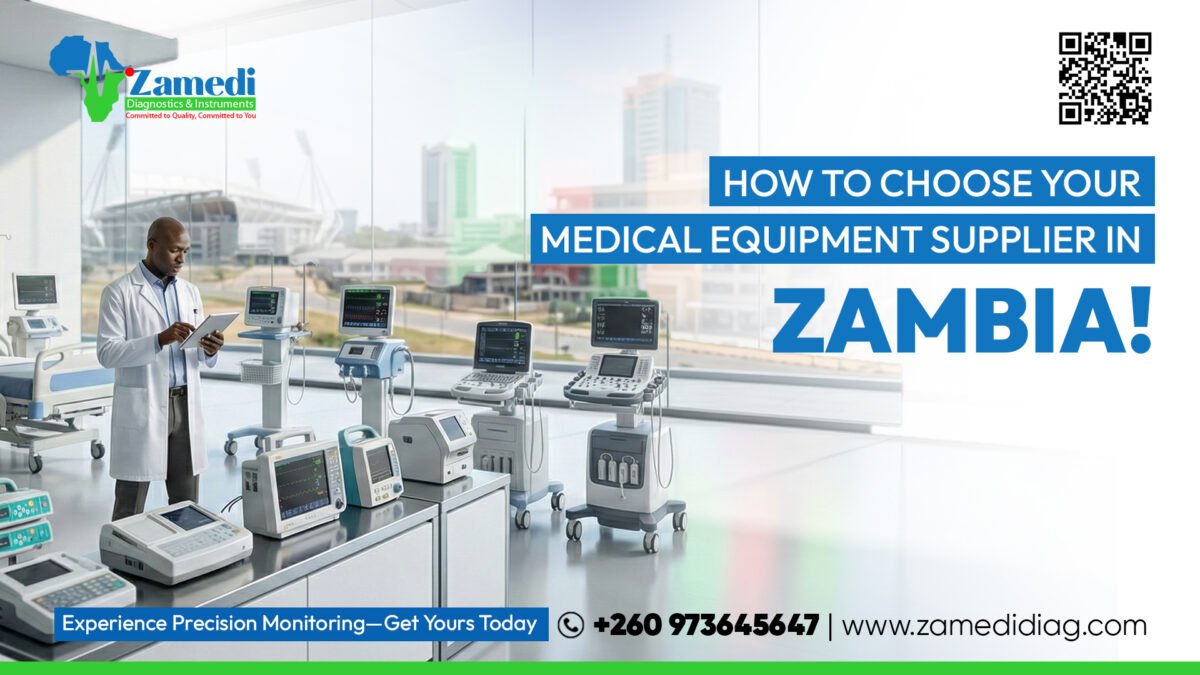
Wondering How to Choose the Best Medical Equipment Supplier in Zambia :
Your Lab & Hospital’s efficiency & operations depends majorly on the medical equipment, and hence it is extremely important to choose a trusted medical equipment supplier that provides the best quality equipment, here are a few important factors that one should keep in mind before finalising on a supplier:
- Trusted MedicalEquipment Manufacturerand Supplier While choosing the Medical Equipment & Instrument in Lusaka one should look for trusted suppliers to ensure premium quality. It is essential to choose a Supplier that can provide Laboratory Equipment, Radiology& Imagining Solutions, Reagents & Lab Consumables Hospital & ICU Furniture, Surgical Equipment & Consumables all under one roof. Zamedi Diagnostics has been the top supplier in medical equipment & instruments in Lusaka for the past decade and aims to bring the best advancements to Zambia.
- Tailor Healthcare RequirementsTake all important factors into consideration, like what advancements are important for that particular department, if the provider is going to provide servicing of the equipment/ instrument or not, if the purchase is going to add value to your medical procedures or department.
- End-to-End SupportFrom selecting Equipment to Installation, Zamedi diagnostic is the only medical equipment supplier in Zambia that provides end to end support. Our team of engineers are present at every step to guide and resolve all queries. Also providing post installation services to ensure servicing and maintenance of equipment on time.
- Fast Response & Local Presence
With our offices at Lusaka and Kitwe, the regional presence allows us to deliver faster, quicker repair/servicing turnarounds, and immediate spare parts availability across Zambia & Africa. We also take prebooking for reagents and supplies to ensure timely delivery and seamless flow. - Regulatory StandardsWhen it comes to lab equipment like Ultrasound Machine, CT or X ray it is very important that they are of high standards and are at par with the Local & International Quality Excellence. Authentic and reliable Equipment suppliers can ensure accuracy and safety and Technical Support as and when required.
- Budget Check Keeping your equipment under your budget is one of the most important factors to consider while considering purchasing medical equipment. Dealing with a leading medical equipment supplier can help you in planning all your purchases under the budget within the best options available.
- Maintenance and Support After sale support is important in solving urgent maintenance needs and operational queries, for a seamless flow of the healthcare facility. Purchasing from a Medical Equipment Company in Zambia will help you in getting proper maintenance and Support. Our experienced technicians provided end to end support for all our clients. Medical Equipment under warranty is another important aspect that one should consider while purchasing any medical equipment. The warranty claims secures your investment in the medical equipment.
- AI IntegrationThe modern era medical equipment requires incorporation of AI that can contribute to the efficiency of the medical equipment. Gradually AI has become an integral part of medical practice. AI-driven features such as predictive analytics, machine learning algorithms, and automation can enhance diagnosis, treatment planning & patient care.
- Data Security Patient data and medical history is the confidential matter in medical services. So, it is one of the foremost factors to consider when buying quality medical equipment. Every time you inspect this criterion for the purchase of medical equipment, your information is not going to be breached in any case.
- Life Expectancy Equipment longevity is a crucial factor to consider while purchasing the equipment for a lab/hospital. A smarter choice is to go for equipment that is durable and can support long operational hours. This can save you form the replacement worries and secure functionality with accurate results.
- CustomisableUser Interface If your equipment allows customization for the user interface it can enhance user/technician experience by accommodating specific workflow preferance. Try to go for equipment that allows customization as per your needs.
- Software Upgrade Software upgrade is necessary when it comes to coping with advancements in medical equipment. Exploring the software and possibility of updating and that of regular updates can ensure up to date technology for a long term. The evolving industry standards of medical equipment enhances patient care methods and hence becomes an important factor while purchasing your equipment.
- Disinfecting & Cleaning of Equipment:Disinfecting & cleaning of all equipment is utmost important to reduce the risk of infection. It safeguards the medical professional and patient’s health. While purchasing the equipment a thorough assessment is inevitable, to facilitate easy cleaning & disinfection.
Conclusion
All the above mentioned factors play an extremely important role while deciding to purchase your lab equipment. Key factors include choosing a trusted manufacturer & supplier, aligning the equipment set up with specific healthcare requirements, adhering to regulatory standards, and managing budget constraints effectively.
Additionally, emphasis on after sale support, maintenance, servicing and on time delivery is extremely important to maintain Seamless operational flow. Advancements with options of regular software updates and AI integration also impacts the credibility of the medical equipment. By evaluating these factors, one can make informed decisions, ensuring the longevity, reliability, and performance before purchasing any medical equipment like, Ultrasound Machine, CT Scan, X Ray Machine or consumables and reagents. At Zamedi Diagnostics we provide the best quality medical equipment and supplies. With our experienced team of technicians we are able to provide technical support and assistance for the installation, maintenance or servicing of the medical equipment procured.
You can reach us at +260 973645647